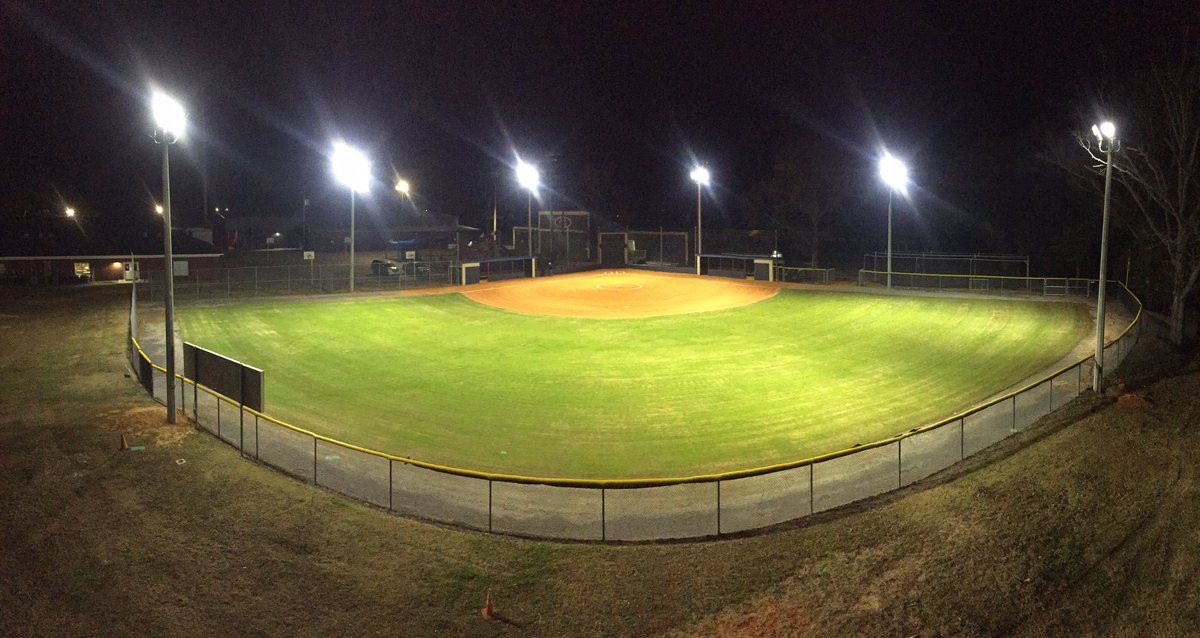
Baseball and softball are enormously popular sports in the US, and the setting sun doesn’t prevent players from competing on the diamond if they can utilize an effective outdoor lighting system. But there’s more to it than just lights.
As demand for evening and nighttime play continues to grow across youth leagues, schools, colleges, and professional venues, proper baseball and softball field lighting has become a critical part of facility planning. Understanding recommended lighting standards, including footcandle levels, uniformity ratios, glare control, pole height, and fixture aiming is essential for ensuring safe and consistent play.
This article will serve as a comprehensive guide for parks departments, athletic directors, facility managers, and municipal planners who need to meet or exceed the lighting requirements for softball and baseball at every level of play.
Who determines the Lighting Standards for Baseball and Softball Fields by Level of Play?
The lighting standards for baseball and softball fields are established by the Illuminating Engineering Society (IES). While the IES is a principal authority regarding lighting standards, it’s essential to understand that they establish a planning baseline rather than a one-size-fits-all solution.
Field size, level of competition, and ball speed influence recommended illumination levels and design complexity. Because of this, lighting standards will vary for youth, high school, college, and professional baseball and softball fields.
IES lighting standards for baseball and softball fields address these aspects:
- Recommended Illuminance Levels are expressed in foot candles (fc) and are based on the level of play (youth/recreational, amateur, collegiate, professional/televised). Foot candles measure the amount of light that reaches a surface area.
- A Uniformity Ratio signifies how evenly the light is distributed across a surface. The goal is to minimize bright spots or dark areas across the field.
- Glare Control Metrics: Glare Rating (GR) or Unified Glare Rating (UGR) are metrics used to prevent excessive brightness. Glare from a light source can cause discomfort and affect the quality of play on a sports field.
What are the differences between baseball and softball fields?
Put simply, softball fields are smaller than baseball fields. There is less distance between home plate and center field, and less distance between bases. As a result, their lighting layout may vary.
Field sizes will vary depending on the level of play, but here are some basic guidelines:
Distance between home plate and the center field wall:
- Baseball = 400 feet
- Softball = 220 feet
Distance between bases:
- Baseball = 90 feet
- Softball = 60 feet
- Little League = 50 feet
Make sure to check your league guidelines for the exact measurements before planning your lighting layout.
What Are the Recommended Foot Candle Levels for Baseball and Softball Fields?
It’s important to know that the infield and outfield of a baseball or softball field will require different lighting levels. The infield will require higher lighting levels than the outfield because activities such as hitting, pitching, throwing, and base running require much more visual clarity. These activities happen at a greater speed, and it’s important that players can see and react to events effectively.
Here are some basic guidelines for baseball and softball field foot candle requirements:
| Level of Play | Area | Foot Candles |
| Pro/Broadcast | Infield | 150 |
| Pro/Broadcast | Outfield | 100 |
| College/Minor League | Infield | 100 |
| College/Minor League | Outfield | 70 |
| High School/Recreation | Infield | 50 |
| High School/Recreation | Outfield | 30 |
| Training/Little League | Infield | 30 |
| Training/Little League | Outfield | 30 |
How Do Baseball Field Lighting Requirements Differ from Softball?
Baseball and softball fields have differences in field geometry, pitching distance, and ball travel, which affect lighting design. Because of this, baseball fields often require different pole placement and aiming strategies compared to softball fields, even when overall field size appears similar.
Why Is Uniform Lighting Important for Player Safety and Performance?
Consistent light levels reduce shadows, improve ball tracking, and minimize eye strain for players, umpires, and officials. Poor uniformity can create unsafe playing conditions and negatively impact game play at all levels.
Lighting uniformity ratios compare lighting levels on a surface (in this case, a sports field) and express how consistently light is distributed across it. A low ratio tells us that there is a smooth light distribution without noticeable dark spots.
For sports field lighting, uniformity ratios are expressed in a “x:y” format. X represents the brightest spot on a surface, and y represents the dimmest spot. For example, a 1.5:1 uniformity ratio means that the brightest spot on a surface is not more than 50% than the dimmest spot.
Little League standards typically limit uniformity ratios to 2:1 in the infield and 2.5:1 in the outfield. For collegiate or professional fields, those numbers are typically below 1.5:1.
How Does Pole Height Affect Field Lighting Quality?
Pole height influences beam spread, glare control, and coverage. For smaller fields, the typical pole height is around 40 or 50 feet. Larger fields will require poles to be 50 to 70 feet, even taller if there are grandstands to clear.
The advantage of using taller poles is that you can aim light fixtures downward. This limits light spillage into nearby areas and prevents glare. They also contribute to better distribution of light and visibility.
How Does Fixture Aiming Help Reduce Glare and Shadows?
Correct fixture aiming directs light onto the playing surface rather than into players’ eyes or surrounding areas. Glare control is especially important for batters, pitchers, and fielders tracking high balls.
A combination of proper pole placement, pole height, and precise aiming contributes to controlling glare and shadows. Utilizing cutoff or shielding optics can also prevent light spillage into nearby roadways and homes if the field is located near residential areas.
It’s important to remember that luminaires mounted on shorter poles will require wider light beam optics (45 to 60 degrees) to prevent glare and light spill. Wider beam optics cover more surface area, but light does not shine as far as narrower beam optics.
What Type of LED Fixtures Are Used for Baseball and Softball Field Lighting?
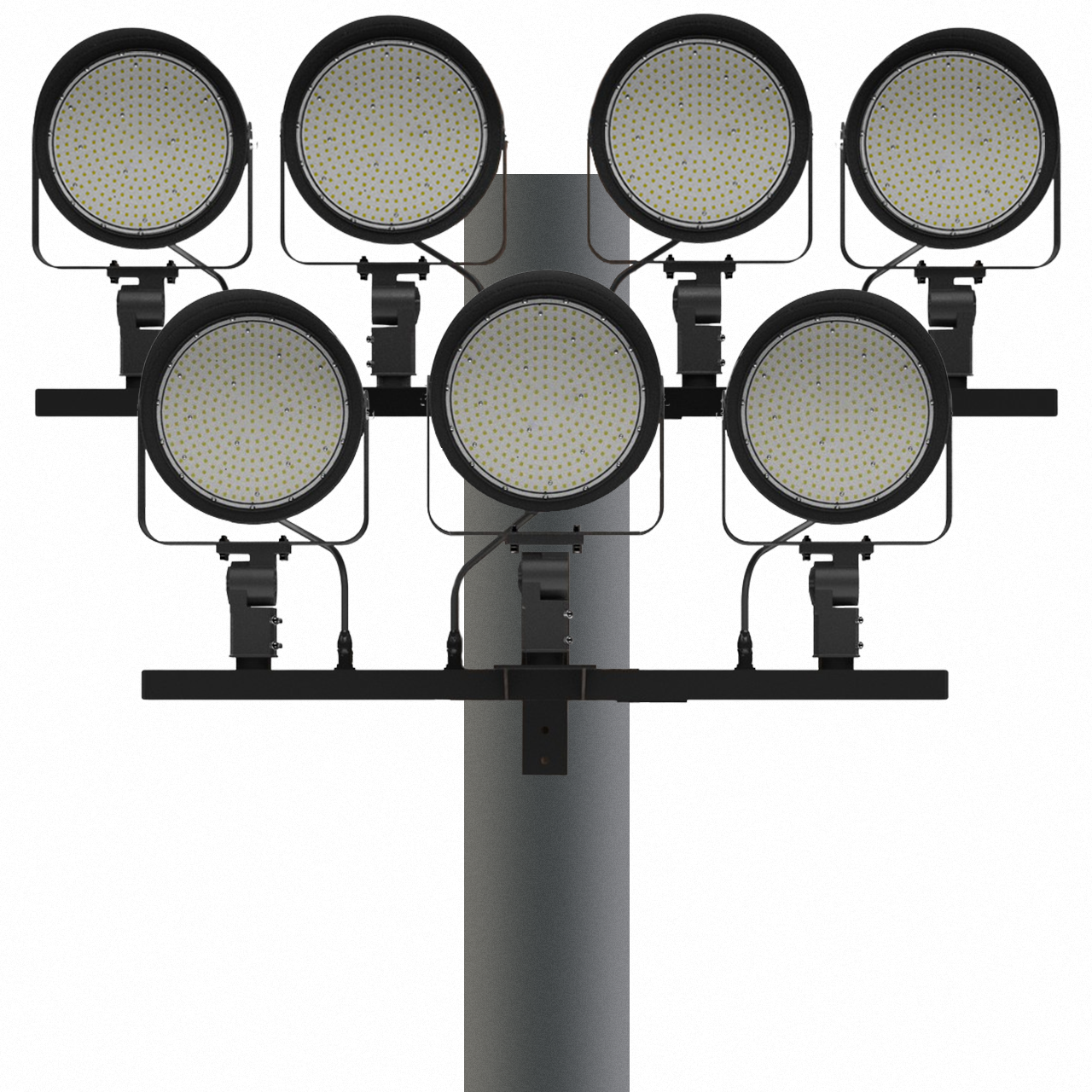
LED sports lighting fixtures deliver high output, precise optics, and long-term efficiency. They are typically mounted on one or more bars at the top of light poles.
The number of light fixtures needed on each pole will depend on a number of variables. These include the number of poles used (along with their height and position), foot candle requirements, and field dimensions. This can be best determined by a photometric lighting plan.
How Many Light Poles Are Typically Needed for a Baseball or Softball Field?
Pole count depends on field size, level of play, and desired lighting performance. For example, youth fields require fewer poles, while higher levels of competition require more precise layouts.
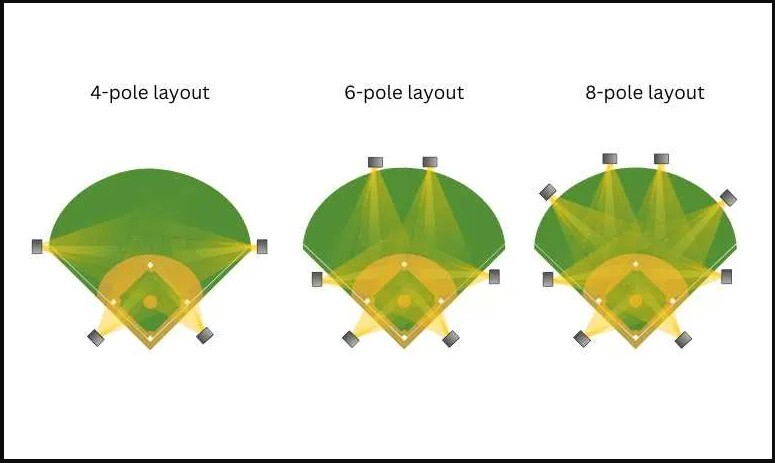
Generally, there are three types of pole configurations used for illuminating baseball and softball fields:
Four-pole configurations
For four pole configurations, two poles should be located on either side of home plate, and two poles should be located near the outfield fence at the foul lines. This configuration is best suited for Little League diamonds and smaller softball fields, where the distance between home plate and the outfield is 200 to 250 feet.
Six-pole configurations
For six pole configurations, two poles should be located on either side of home plate, two poles should be located near 1st and 3rd bases, and two poles should be located in the outfield. This configuration is best suited for high school and collegiate fields.
Eight-pole configurations
Eight pole configurations will be the same as six pole configurations, with two additional poles located in the outfield. This configuration is best suited for the highest levels of play and televised games.
When eight properly positioned poles are employed, designers can utilize narrower beam angles and fewer light fixtures per pole. This reduces glare and power use without compromising the overall quality of the lighting. This setup results in fewer shadows, increased control, and lower energy costs in the long run.
How Can LightMart Help Design a Standards-Compliant Baseball or Softball Field?
Sports facilities managers will need to engage early in the planning process to ensure compliance, safety, and long-term performance when illuminating their baseball and softball fields.
LightMart supports projects with standards-based design guidance, LED lighting systems, pole selection, and turnkey solutions for baseball and softball fields. Contact us today!
David DeWald is the E-Commerce Marketing Specialist at LightMart. He has been working in the industrial and commercial lighting industry since 2013 and is based in the greater Chicago area. David specializes in digital product management, web content writing, and product marketing. He regularly publishes lighting industry-related articles on the LightMart blog. You can visit his LinkedIn profile here.