
Soccer, known as “the beautiful game”, is wildly popular around the world. It’s played at all levels, from casual recreational leagues to the FIFA World Cup event held every four years.
As the demand for lighting for community sports fields continues to rise across recreational leagues, schools, and professional venues, soccer field lighting has become a crucial element of facility planning. Understanding the correct lighting standards, including foot candle levels, uniformity, glare control, pole height, and beam angle, is essential for ensuring both safety and performance on the field.
Designing an effective soccer field lighting system requires considerable planning. The size of the field, level of play, and the presence of spectators will dictate the amount of light you’ll need. For example, a televised professional game will require more complex lighting than a high school soccer game. It’s important to adapt the field’s lighting design to meet the needs of players and spectators.
This article will serve as a comprehensive guide for facility managers, sports complex developers, athletic directors, and municipal planners who want to meet or exceed recommended lighting guidelines.
Lighting Terms and Soccer Field Dimensions
Before we outline the soccer field lighting requirements, it’s important to understand its dimensions and some key lighting terms.
Understanding Soccer Field Dimensions
The size of a soccer field will depend on the level of play. The size will also depend on the number of players on each team (like 7v7 or 9v9), player age, and governing body regulations. However, some areas of the field will always have the same dimensions, regardless.
- The center circle diameter is 60 feet.
- The penalty box is 54 x 132 feet.
- The goal area is 18 feet deep.
The size range for youth soccer fields can range from 25 x 20 yards, which applies to 3 vs 3 or 4 vs 4 formats, to 120 x 75 yards, which applies to 11 vs 11 formats.
The general guidelines for higher levels of play are as follows:
| Level of Play | Length | Width |
| High School | 100-120 yards | 55-80 yards |
| Collegiate | 115-120 yards | 70-75 yards |
| FIFA Regulation | 100-130 yards | 50-100 yards |
| FIFA International | 110-120 yards | 70-80 yards |
A soccer field is symmetrical on both sides, which helps determine light pole placement.
Understanding Key Lighting Terms
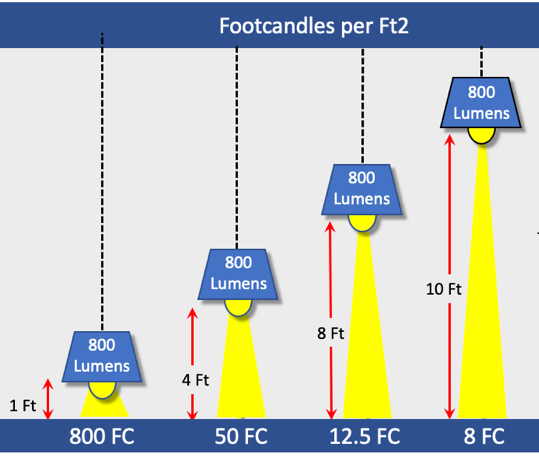
Foot-candles (fc) vs. Lumens: Brightness is measured in two ways: foot candles and lumens. Put simply, lumens measure the amount of light emitted by a light source, whereas foot candles measure the amount of light that reaches the surface of the area to be illuminated. On a soccer field, the light level reaching the field is measured in foot-candles. The mounting height of a light will affect how much light reaches the surface. The higher it is mounted, the less light (foot candles) will reach the surface, as shown in the diagram below.
Uniformity Level: This is a value calculated during the design process that measures how evenly light is distributed on the field. It is based on a scale of 0 to 1. It’s important to avoid lighting that is brighter in some areas of the field than others. Consistent lighting across the field reduces shadows and eye strain for players and referees. Mounting height also affects light spread and shadow control. Pole height plays a significant role in ensuring uniform light coverage across an area.
Color Temperature (CCT): Correlated Color Temperature refers to the color of light emitted from a light source and is measured in Kelvin (K). Lower Kelvin values indicate warm (yellow) light, and higher Kelvin values indicate cool (white/blue) light.
Color Rendering Index (CRI): The Color Rendering Index evaluates a light source’s ability to accurately display the colors of objects compared to natural light and is expressed on a scale of 0-100. A CRI of 100 is equivalent to natural sunlight.
What are the recommended light levels for soccer fields?
As the level of play and field size increase, higher light levels will be needed for nighttime play that meet soccer field lighting standards. Even more so if there is an increase in spectators and/or the game is televised. The Illuminating Engineering Society (IES) recommends the following:
| Level of Play | Foot Candles (fc) | Uniformity Level | CCT | CRI |
| Elementary Schools, Recreational | Average of 20 | 0.5 | 4200-6200K | ≥ 70 |
| Small High School Fields, Training Facilities | Average of 30 | 0.6 | 5000-6200K | ≥ 70 |
| Large High School Fields, Amateur Leagues | Average of 50 | 0.7 | 5000-6200K | ≥ 80 |
| Collegiate, Semi-Pro, Sports Clubs | Average of 75 | 0.7 | 5000-6200K | ≥ 80 |
What is the ideal pole height and beam angle for soccer field lighting?
The dimensions of a soccer field (total area) and the level of competition are the two main factors that determine the number of lighting poles needed to light up your soccer pitch.
Soccer field pole height typically ranges between 40 and 70 feet, depending on the field size and level of play. Taller poles with narrow beam angles are used for high-lumen, broadcast-level fields, while shorter poles with wider angles may suit community or training fields. Symmetrical pole placement, proper aiming, and fixture spacing ensure even light distribution.
When light fixtures are mounted on taller poles, glare is less likely to be visible to players or spectators. This results in a better viewing experience. The sharp angle of lamps on taller poles also contributes to reducing the amount of light spillage.
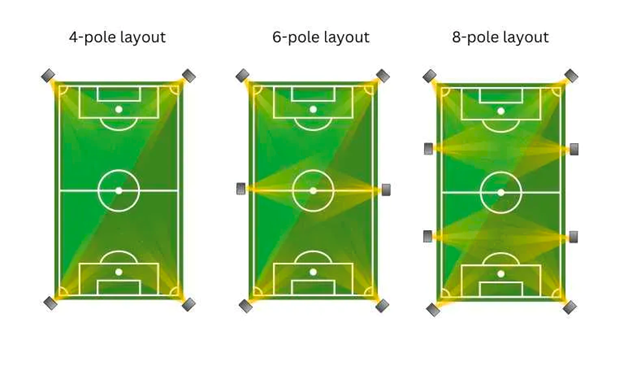
There are three types of pole configurations used to light a soccer field: 4-pole, 6-pole, and 8-pole. Field size and play level will determine the number of poles needed.
- Local Training, School, and Recreational Level: 4-pole configurations place each pole near the penalty area lines, two poles on each side of the field.
- High-Level Training, Semi-Professional, High School: 6-pole configurations place two poles on either side of the mid-field line and one pole at each corner of the field.
- Professional and Championship Soccer Games: 8-pole configurations place one pole at each corner of the field and two poles each on the sides of the field, evenly spaced along the center line.
If there are bleachers, the poles are placed behind them in the same positions.
What are the best types of light fixtures to use for soccer fields?
LED Sports Lights are the ideal fixtures to use for soccer field lighting. LED soccer field lights are superior to standard HID lights in many ways:
- Longer lifespan: Typically, 50,000 to 100,000 hours of life.
- Reduced maintenance costs: Their durability and long life result in less frequent replacement and labor expenses. This is especially important when they are mounted on tall poles, making them more labor-intensive to replace.
- High-intensity light output: Some LED sports lights produce up to 200,000 lumens per fixture, which is more than sufficient for larger fields.
How can LightMart help with soccer field lighting projects?
LightMart offers personalized lighting recommendations, custom layout support, and complete LED lighting packages.
Our soccer lighting systems are engineered for durability, energy efficiency, and compliance with sports lighting requirements.
Our knowledgeable staff can help you design your outdoor soccer field lighting project. We also offer lighting packages for other types of sports lighting systems. Contact us today!
David DeWald is the E-Commerce Marketing Specialist at LightMart. He has been working in the industrial and commercial lighting industry since 2013 and is based in the greater Chicago area. David specializes in digital product management, web content writing, and product marketing. He regularly publishes lighting industry-related articles on the LightMart blog. You can visit his LinkedIn profile here.