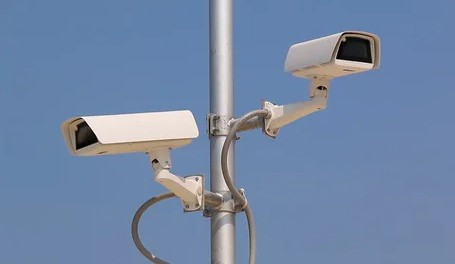
Security cameras can be mounted around a commercial property in many ways. These include on walls, under roof overhangs, and on top of poles.
Pole-mounted security cameras have many benefits over other types of mounting:
- They have a wider field of view.
- They are better positioned to monitor boundaries and entry points.
- They have better placement flexibility.
- They are difficult to tamper with.
- You can install multiple cameras on a single pole.
As parking lots, commercial properties, and industrial sites continue to expand, selecting the right infrastructure for surveillance systems has become a critical part of project planning. One of the most important decisions engineers, contractors, and property owners face is choosing between aluminum and steel security camera poles, as this directly impacts durability, installation, and long-term performance.
This article will provide readers with a pole material comparison between aluminum and steel across key factors such as strength, corrosion resistance, environmental suitability, and installation considerations. It will help stakeholders determine which material best aligns with their project requirements, budget, and long-term goals.
Why does material selection matter when choosing security camera poles?
Choosing between aluminum and steel impacts durability, structural performance, and long-term system reliability, especially during project design, installation planning, and lifecycle management.
Key differences such as strength, weight, corrosion resistance, and cost establish a clear foundation for material selection decisions.
- A pole’s strength will determine how safely it can handle local wind conditions and the weight of the equipment installed on it.
- A pole’s weight will determine the difficulty level of its installation.
- A pole’s ability to resist corrosion will determine its typical lifespan.
- A pole’s cost will determine its economic feasibility for a project.
When should you choose aluminum security camera poles?
Aluminum poles are ideal for environments where corrosion resistance, lightweight installation, and low maintenance are priorities.
Common use cases:
- Coastal environments where moisture and salt in the air cause additional corrosion concerns.
- Areas where salt is used to melt snow and ice on driving surfaces.
- Areas that require easier handling, cheaper transport, and faster installation.
Hinged-base aluminum security camera poles are an additional option that allows you to lower the pole to the ground. This allows easy access to the security equipment and/or light fixtures mounted to the top of the pole without the use of ladders or lifts.
When should you choose steel security camera poles?
Steel poles are best suited for projects requiring higher strength, load capacity, and structural stability.
Common use cases:
- Large parking lots where taller poles (security camera pole height exceeding 20-25 feet) are required.
- Industrial facilities where poles are at risk of impacts from large equipment.
- Installations with multiple cameras or heavier equipment.
How does environment impact the choice between aluminum and steel poles?
Factors such as moisture, coastal exposure, wind loads, and temperature fluctuations affect material performance. Corrosion risk and environmental stress should guide material selection. Choose steel poles for high-wind areas and for applications that require structural stability. You should use aluminum poles in areas that require corrosion resistance and can handle lighter loads.
How do installation requirements and long-term maintenance differ between aluminum and steel poles?
Installation considerations, such as weight, handling, and installation time, will factor into your decision between steel and aluminum poles. Aluminum poles are easier to install than steel poles because they weigh much less. In most cases, they are around one-third of the weight of a comparable steel pole. This also makes them easier and cheaper to transport.
Due to their corrosion-resistance, aluminum poles are low-maintenance compared to steel poles. They don’t need to be galvanized or painted because they naturally form a protective oxide layer. Steel may provide greater long-term structural performance depending on the application.
What are the most common mistakes when choosing between aluminum and steel poles?
Selecting materials without considering environmental conditions. For example, if steel poles are installed in a coastal area, the high humidity and salt in the air will likely reduce their lifespan due to corrosion.
Underestimating load requirements. Structural failure of the poles will occur if they can’t handle the load capacity of the equipment mounted on them and/or if they cannot handle the local wind conditions. Steel poles are better equipped to handle heavy loads safely due to their strength. Always consult a pole’s EPA table before deciding on a purchase.
Focusing only on upfront cost above all other considerations. Steel poles cost less money upfront than aluminum poles, but they have a shorter lifespan. They are more expensive to maintain and need to be replaced sooner than their aluminum counterparts.
How does LightMart support security camera pole selection and system design?
LightMart offers both aluminum and steel security camera poles tailored to different applications.
We also offer fiberglass security camera poles. Although generally more expensive than steel or aluminum poles, they are lightweight, non-conducting, rust- and corrosion-proof, and vibration-resistant.
LightMart’s expert guidance helps engineers, contractors, and property owners select the right material for reliable, long-term performance.
Our experts can design tailored solutions, including CAD drawings, security camera pole layouts, and custom bracket recommendations to meet your project’s unique requirements. Contact us today!
David DeWald is the E-Commerce Marketing Specialist at LightMart. He has been working in the industrial and commercial lighting industry since 2013 and is based in the greater Chicago area. David specializes in digital product management, web content writing, and product marketing. He regularly publishes lighting industry-related articles on the LightMart blog. You can visit his LinkedIn profile here.
CCTV Camera Poles