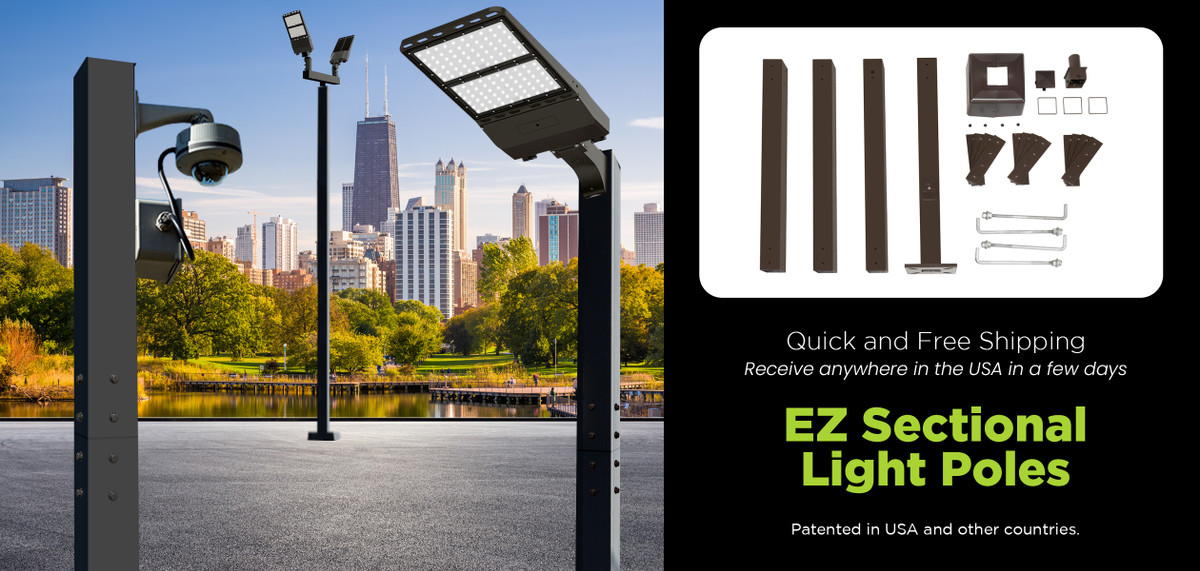
Conventional commercial light poles have been the norm for commercial lighting projects for decades. However, their size and weight can create a multitude of transportation, storage, and installation challenges. Additionally, these challenges intensify as their weight and height increase.
LightMart’s modular, patented EZ Sectional light poles are an alternative designed to simplify logistics that improves shipping, handling, and installation efficiency.
This article will compare sectional light poles and conventional one-piece poles, helping contractors, municipalities, and commercial property owners understand when modular pole designs offer meaningful advantages.
Understanding Conventional One-Piece Light Poles
How Conventional Light Poles Are Built
Conventional commercial light poles are manufactured as a single shaft. The finished product is delivered to the installation site as a complete pole. This is common across commercial, municipal, and industrial projects.
Conventional one-piece light poles are widely specified and accepted. They are available in numerous sizes and configurations depending on their application and installation type.
Common Challenges with Conventional Light Poles
- Difficult transportation for longer poles – Specialty carriers are required for delivery due to their size.
- Large storage requirements – If stored for later use, they will occupy a lot of space.
- More challenging jobsite handling – Their size and weight can make them a bit unwieldy to move around, especially steel poles, which are the heaviest of the three standard pole materials.
- Additional equipment may be required during installation, depending on the height and weight of the poles.
What Are Sectional Light Poles?
Sectional light poles have a modular design and are manufactured in multiple sections. They are designed to maintain commercial-grade performance and are assembled on-site.
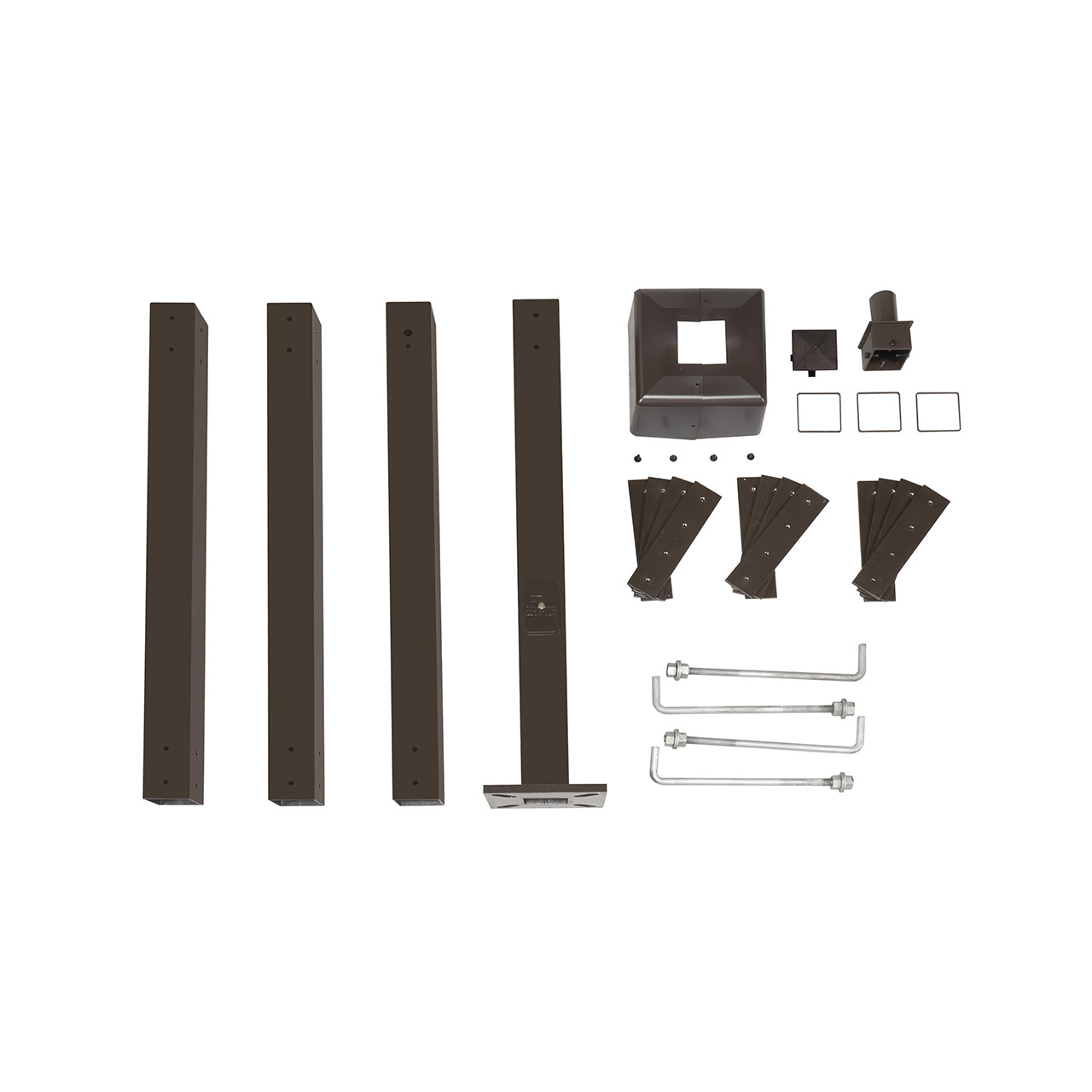
LightMart's EZ Sectional Light Pole System is designed for outdoor commercial applications and has a patented design that ships in manageable sections. These systems are intended to meet a growing demand for flexible installation solutions due to an increased focus on installation efficiency and increasing transportation challenges.
Shipping and Transportation Comparison
Conventional One-Piece Pole Logistics
The size and shape of conventional light poles present some logistical challenges. One of these challenges is their transportation to the job sites where they will be installed. They can’t simply be loaded onto a standard delivery van like a typical package. You’ll need to use experienced specialty carriers who can safely and effectively handle the load. In most cases, flatbed trucks or semis are used for transport. As a result, shipping costs are high for conventional light poles.
To reduce shipping costs for the customer, many businesses use freight consolidation companies. The drawback to this is that typical transportation lead times are around two weeks.
Benefits of Sectional Light Pole Shipping
The EZ Sectional Light Pole disassembled pole components are packed in boxes and shipped via standard carriers like UPS or FedEx. This means that poles are received a few days after ordering (depending on delivery location). No specialty carriers are needed.
Delivery, Storage, Installation, and Jobsite Efficiency
Delivery Considerations
Transporting conventional light poles isn’t the only challenge. When they reach the site for delivery, customers or contractors are responsible for offloading the poles. With specialized carriers, delivery times must be planned in advance, and you’ll need to have the proper equipment such as cranes or forklifts to ensure that the poles are not damaged.
The delivery of light poles is even more complicated when the destination is a residential zone. You’ll need to ensure the carrier can easily enter and leave the area. Their trucks are large, and they need to have the ability to safely maneuver in and out. For example, if a delivery is being made to a townhouse complex, the driver may refuse to enter if it’s determined that there are safety or logistical concerns. There are also residential delivery surcharges, which make it even more expensive.
The EZ Sectional Light Pole delivery can be made to commercial or residential areas without issue. A flatbed truck is unnecessary so that delivery can be made safely and without special considerations. There is also no need to make a delivery appointment, as no special equipment is required to offload the poles.
Storage and Handling Considerations
Conventional poles require a large amount of storage and staging space, which can present challenges on active job sites. Sectional poles provide greater flexibility on these types of sites because they offer easier movement around constrained project environments.
Sectional poles can be palletized for easier storage, unlike conventional poles.
Installation Considerations
Conventional light poles often require additional equipment to lift and maneuver during the installation process, especially steel poles due to their weight. This also creates challenges when site access is limited.
Unassembled sectional poles are much easier to move around a jobsite and can then be assembled at the location they will be installed.
Are Sectional Light Poles Right for My Project?
There are several factors to consider when determining whether sectional light poles are right for your project.
Evaluate Transportation and Delivery Requirements
- Will transportation of the poles to the delivery site require the use of specialty carriers rather than standard carriers such as UPS or FedEx?
- Will delivery access be an issue? For example, is the installation site difficult to get to or in a residential area?
- Will you be able to offload one-piece conventional poles when delivered using equipment such as cranes or forklifts?
- Will there be staging area or storage limitations? If the poles require staging or storage space before installation, will you have enough to accommodate them?
When a Conventional One-Piece Pole Makes Sense
- Projects with unrestricted site access
- Existing specifications requiring conventional poles
- Applications where transportation is not a concern
- Standard municipal installations
When a Sectional Light Pole Makes Sense
- Difficult transportation routes
- Limited staging space
- Challenging installation environments
- Projects prioritizing installation efficiency
- Sites with restricted access
What are the Ideal Project Types for Sectional Poles?
- Urban developments
- Restricted access locations
- Retrofit projects
- Campus environments
- Municipal improvements
- Backyard sports courts
- Parking Lots
Why Choose a Sectional Light Pole?
Traditional light poles can create logistical challenges throughout a project, from shipping and storage to installation and handling. Modular light poles address these issues by allowing the pole to be transported in sections and assembled at the installation site.
This approach can simplify project planning, reduce transportation concerns, and make installation more manageable for contractors and maintenance teams. For projects with limited access, limited storage space, or challenging delivery conditions, sectional light poles offer a practical alternative to conventional pole designs.
LightMart offers its patented EZ Sectional Light Poles in 8-, 12-, 16-, and 20-foot sizes. These sectional steel light poles ship for free in a few days and are easy to assemble. You won’t find them anywhere else. Contact us today!
FAQs
What is a sectional light pole?
Sectional light poles have a modular design and are manufactured in multiple sections. They are designed to maintain commercial-grade performance and are assembled on-site.
What is the difference between a sectional light pole and a conventional light pole?
Conventional commercial light poles are manufactured as a single shaft. The finished product is delivered to the installation site as a complete pole. Sectional light poles have a modular design and are manufactured in multiple sections. They are designed to maintain commercial-grade performance and are assembled on-site.
Are sectional light poles as strong as conventional poles?
Yes. In some cases, they are stronger than equivalent poles due to their connecting plates. This also makes them more resistant to vibration.
What are the advantages of sectional light poles?
- They are easier and cheaper to ship.
- They do not require special equipment to offload at the delivery site.
- They require less staging and storage space.
Are sectional light poles easier to transport?
Yes. They do not require specialty carriers for transport and can be delivered by standard delivery van.
When should I choose a sectional light pole?
- Difficult transportation routes
- Limited staging space
- Challenging installation environments
- Projects prioritizing installation efficiency
- Sites with restricted access
David DeWald is the E-Commerce Marketing Specialist at LightMart. He has been working in the industrial and commercial lighting industry since 2013 and is based in the greater Chicago area. David specializes in digital product management, web content writing, and product marketing. He regularly publishes lighting industry-related articles on the LightMart blog. You can visit his LinkedIn profile here.